

You feel like there’s a pebble wedged under the ball of your foot, or a sock seam folded the wrong way. You stop, pull off your shoe, check. Nothing’s there. That phantom lump, usually paired with a burning or electric jolt between the third and fourth toes, is how Morton’s neuroma announces itself. It can flatten a midday errand into something you’d rather skip.
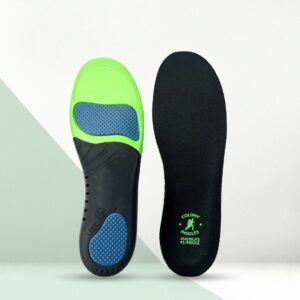 America’s #1 Insole
Premium Colony Insoles
- Recommended by podiatrists
- Memory foam + gel with real arch support
- 60-day money-back guarantee
- Free shipping within the USA
What’s actually happening is a nerve problem. The tissue around one of the nerves running between your toes thickens and gets cranky, and then the metatarsal heads above it press down with every step and pinch it further. Narrow shoes squeeze the bones together. A forefoot with no real support underneath it lets all your weight land in exactly the wrong spot. The nerve has nowhere to go, so it complains.
Where our insole comes in
We built the Colony insole around the idea that the ball of the foot deserves a cushion, not a hard ramp. Memory foam molds to your forefoot and a gel layer underneath soaks up the impact, so each step lands soft instead of sharp. Just as important, we shaped the arch with real geometric structure so it lifts and spreads your load across the whole foot. That’s the part people miss: take pressure off the irritated spot and the nerve gets a chance to settle.
Who tends to feel this
Nurses pacing a unit, teachers on tile all day, runners logging miles, anyone living in dress shoes with a snug toe box. If your work or your shoes crowd the front of your foot, the metatarsal nerves take the hit.
What the insole does for a neuroma
- Memory foam and gel together, cushioning the ball of the foot where the neuroma lives
- Structured arch support that pulls pressure away from the angry nerve
- Real shock absorption to quiet the repeated jolts that keep it inflamed
- A podiatrist-recommended build that holds up to standing, walking, and running
- A slim profile that drops into sneakers, work shoes, and dress shoes without crowding your toes
Feet are individual, so it’s worth reading around. If your pain shows up more in the heel and arch, see our guide on insoles for plantar fasciitis. If you’ve got tall, rigid arches, our shoe inserts for high arches page will help you dial in the fit.
Nobody should be mapping out their day around where it’ll hurt to walk. Memory foam, gel, and a genuinely supportive arch give that nerve room to calm down. We keep the decision low-stakes: free shipping anywhere in the USA and a risk-free 60-day money-back guarantee. If they don’t help, send them back, no argument from us.
One insole, made well, $29 a pair. Give your forefoot the cushion it’s been missing.
Related Insoles & Guides
- Insoles for Sciatica: Support & Relief
- Insoles for Shin Splints Relief
- Insoles for Bunions: Cushioned Relief
- Shoe Inserts for Foot Pain Relief
- Plantar Fasciitis Explained: Causes & Relief
- Running Insoles for Arch & Heel Relief
Frequently Asked Questions
How do these insoles help Morton’s neuroma?
Morton’s neuroma flares when the metatarsal heads press down and pinch the irritated nerve between your toes. The cushioning across the forefoot softens pressure on the ball of the foot, while the arch support helps offload the metatarsals so the nerve is squeezed less with each step. The goal is to calm that sharp, burning, pebble-under-the-toes feeling.
Do these have a metatarsal pad built in?
Our insole is a full-length memory foam and gel design with structured arch support and forefoot cushioning rather than a separate raised met pad. Many people with mild to moderate neuroma get relief from the added forefoot cushioning and better support alone. If your podiatrist has prescribed a specific met-pad placement, that is worth discussing with them too.
Will they fit in narrow or tight shoes that trigger my symptoms?
They are trim-to-fit, so you can size them to your shoe, but tight, narrow shoes are a common neuroma trigger no matter the insole. For the best results, pair the insoles with a roomier toe box that lets the forefoot spread. Remove the factory liner first so the cushioning sits flat.
How should I insert and position them for forefoot relief?
Take out your shoe’s existing insole, place ours heel-first so the heel seats fully, then press it flat toward the toes. Proper heel seating keeps the arch and forefoot cushioning where they belong. Trim only the toe end along the guide lines so you do not disturb the support zones.
What if they do not relieve my neuroma pain?
They are backed by a risk-free 60-day guarantee. Wear them on the walks that usually bother you, and if the ball-of-foot pain is not improving, return them for a full refund. US shipping is free, so there is no risk in trying them.