

The Clue Was Six Letters. The Real Thing Is More Interesting.
If a crossword sent you typing “shoe inserts” into a search bar, you’ve landed in the right square. It’s a tidy puzzle answer, but it’s also a real piece of gear that quietly changes how your feet feel by the end of a day. I’m Jack Young, and since you’re already here, let me make the detour worth it. There’s a lot more to a good insert than fitting it into a grid.
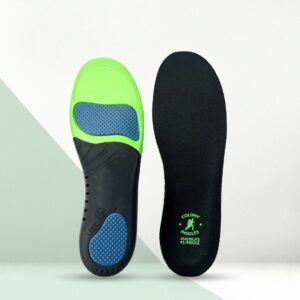 America’s #1 Insole
Premium Colony Insoles
- Recommended by podiatrists
- Memory foam + gel with real arch support
- 60-day money-back guarantee
- Free shipping within the USA
What That Little Slab Inside Your Shoe Is Actually For
An insert, also called an insole, lives between the sole of your foot and the footbed of your shoe. The thin liner that came in the box does almost nothing. It’s there to finish the shoe, not support you. A purpose-built insert fills the gap underneath your foot, cushions the pounding, holds your arch, and spreads pressure so no single patch takes the whole beating. For anyone who stands, walks, or runs for hours, that spread is the difference between feet that are fine at closing time and feet that are done by lunch. A lot of people have decided that sore, tired feet are just the cost of getting older or working hard. Usually they’re not. Usually they’re a sign the shoe isn’t holding up its end, which is a far cheaper fix than people expect.
How We Built Ours
We make one insole and put everything into it. Memory foam and gel handle the cushioning, structured, geometric arch support keeps your foot stacked where it belongs, and the build delivers real shock absorption stride after stride on hard ground. It’s podiatrist-recommended and runs $29 a pair, no puzzle required to work out the value.
- Memory foam and gel cushioning for the long haul of a day
- Geometric arch support that keeps your feet aligned
- Shock absorption built for concrete and double shifts
- Molds to the shape of your own foot over the first few wears
- Helps you stand, walk, and run without the afternoon ache
Who This Tends to Suit
Crossword regulars, sure. But honestly, anyone whose feet could use backup. If you came for the word and stuck around for the comfort, our arch support inserts page and our rundown on inserts for ball of foot pain are both written like a person talking, not a brochure.
You solved the clue. The foot pain is the next one across. Order today with free USA shipping and a risk-free 60-day money-back guarantee, so you can try them with nothing on the line. Grab a pair of Colony Insoles.
Related Insoles & Guides
- Gel Insoles for Real Shock Absorption
- Magnetic Shoe Inserts vs. Real Support
- Z-Liner Insoles: Slim Fit + Real Support
- Best Shoe Inserts for All-Day Comfort
- Heel Inserts for Heel Pain Relief
- Height-Boosting Shoe Inserts
Frequently Asked Questions
What is the crossword answer for shoe inserts?
The common crossword answer is INSOLES, though shorter grids sometimes use ARCHES or PADS depending on the letter count. An insole is the real-world item: a liner that sits inside your shoe between your foot and the footbed. So the puzzle clue points to something genuinely useful.
What does a shoe insert actually do?
A shoe insert, also called an insole, replaces the thin, generic liner most shoes ship with. A good one adds structured arch support and cushioning so impact is absorbed and pressure is spread across your foot. The result is feet that feel more supported and tire less over a long day.
Do I really need an insole if my shoes came with one?
Stock liners are usually thin foam that offers almost no arch support and flattens quickly. Swapping in a purpose-built insole gives you support and shock absorption the factory liner never provided. You can see what ours includes on the product page.
How do I put an insole in my shoe?
Pull out the original factory liner, set our insole in heel-first, and press it flat so it seats fully. If it’s a touch long, trace the old liner on top and trim along our printed guides. Cut a little at a time so you don’t take off too much.
Is it worth ordering since I just came for the clue?
Since you’re here, it’s a low-risk way to try real support. The insole is $29 a pair with free US shipping and a 60-day money-back guarantee, so you can return it if your feet don’t feel the difference.